

Far-right candidate Flávio Bolsonaro, of the Liberal Party (PL), finished the first round ahead of President Luiz Inácio Lula da Silva, of the Workers’ Party (PT): 47.03% versus 45.16% of valid votes. The two will face off again on October 25. The PL now holds the largest blocs in both the Chamber of Deputies and the Senate, and whoever wins will govern with a Congress dominated by the far right. The race for the Federal Supreme Court is also at stake, as the next president will appoint four justices to the Court.
What were the results?
With 100% of the votes counted, Flávio received 56.1 million votes and Lula, 53.9million. The margin was 2.2 million votes, or 1.87 percentage points. Blank and invalid votes totaled 4.8%. Voter abstention reached 21%, or about 33.5 million people.
The next four candidates accounted for 7.6% of the vote and are all to the right of Lula:Augusto Cury (Avante), Renan Santos (Missão), Ronaldo Caiado (PSD), and Romeu Zema (Novo). The other six candidates combined for 0.2%. This is the first time since 1998 that Lula has finished in second place in the first round. In 2022, he beat Jair Bolsonaro by 5.23 percentage points. Lula lost about 3.4 million votes compared to that first round.
Results by state
The geographic map of the distribution of votes is quite clear. Flávio won in all states in the South, Southeast, and Midwest, in the Federal District, and in four states in the North. Lula won in all nine states in the Northeast, as well as in Pará, Amazonas, and Amapá. Minas Gerais, which typically follows the national trend, gave 48.25% of its vote to Flávio and 43.31% to Lula.
The regional distribution of the vote is, however, nuanced when municipal results are also considered.
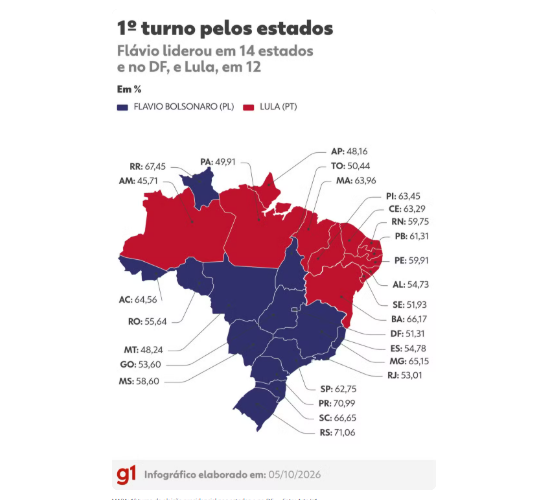
The governors
The PL was the party with the most governors elected in the first round: six (Paraná, Rio de Janeiro, Rio Grande do Sul, Rondônia, Roraima, and Santa Catarina). In addition, parties allied with the PL won another five states in the first round (Mato Grosso, Mato Grosso do Sul, Paraíba, São Paulo, and Pará). The PT won only three states (Ceará, Bahia, and Piauí), and its allies will face a runoff in four states.
Congress
The election decided 54 of the 81 Senate seats. The PL is expected to begin the legislative session in February 2027 with 28 senators, one-third of the Senate. According to Agência Senado, this is the largest single-party caucus at the start of a legislative session since 1988.
In the Chamber of Deputies, the Chamber’s own projections give the PL 121 of the 513 seats, up from 99 in 2022. The coalition of the PT, PCdoB, and PV comes in second, with 82 seats. Lula’s allies suffered symbolic defeats. Former ministers Gleisi Hoffmann, in Paraná, and Simone Tebet and Marina Silva, in São Paulo, were not elected to the Senate. Renan Calheiros was not reelected in Alagoas. On the other hand, Michelle Bolsonaro, the wife of Jair Bolsonaro was the most voted senator in the Federal District, and Nikolas Ferreira was once again the House representative with the most votes in the country, with 3.1 million votes.
Predictable consequences
With these numbers in the Chamber of Deputies and the Senate, the far right has gained leverage to negotiate with the so-called Center to propose and pass constitutional amendments. Meanwhile, the increase in the number of its senators opens the door to changes in the rules of the Federal Supreme Court and the impeachment of justices. If Lula wins, he will therefore face opposition from Congress and the governors of four major states in the Center-South.
If Flávio wins, he will have a congressional majority and the support of those governors, but will face opposition from PT governors in the Northeast.
Why were the electoral polls wrong?
On the eve of the election, most polling firms showed a virtual tie, with Lula numerically ahead in most polls. Only Gerp gave Flávio the lead. The Datafolha poll from October 3 correctly predicted Lula’s percentage of the vote but was off by about five points for Flávio. That poll, with 4,006 respondents and a margin of error of 2 points, did not indicate the significant decline in support for candidates Augusto Cury, Renan Santos, Ronaldo Caiado, and Romeu Zema, who, combined, lost 3.4 points between the poll and election day. This difference accounts for more than half of the error.
But neither did polls released in the weeks leading up to the election indicate this discrepancy: the BTG/Nexus poll, released a week earlier, showed Lula at 42% and Flávio at 37%. There are two explanations for what happened, and one does not rule out the other. The first is last-minute tactical voting: right-wing voters shifted their support to Flávio after days of campaigning for a first-round victory. The second is a measurement error, since it has been known since 2022 that Bolsonaro supporters either do not respond to polls or indicate support for another right-wing candidate when they do. Only studies conducted after the election will be able to distinguish between the two.
Compilation
Portuguese
Data assessments
Congresso amplia presença feminina, mas vê avanço antifeminista – Folha de São Paulo
Bancada feminina bate recorde e é mais de esquerda que total da Câmara – Folha de São Paulo
Número de pessoas LGBT+ eleitas neste ano dobra em relação a 2022 – Carta Capital
Quem são as pessoas LGBTQIA+ eleitas em 2026 – Agência Diadorim
Quem é Thabatta Pimenta, primeira deputada federal trans do Nordeste – Folha de São Paulo
Jovens de direita e extrema-direita são maioria entre eleitos em 2026 – O Globo
Bancada evangélica perde 4 de 5 presidentes, e urnas desgastam velha guarda – Folha de São Paulo
Outcome assessments
Vladimir Safatle e Jamil Chade comentam o resultado do 1º turno | Direto da Redação – Carta Capital
Para além da desolação – Revista Piauí
Flávio Bolsonaro na frente de Lula: o que isso diz de um povo? – Sumauma
A síndrome do segundo mandato – Folha de São Paulo
Spanish
Lula contra un tsunami conservador – Nuso
Brasil y el problema que las izquierdas todavía no quieren mirar – Marco Fonseca (Substack)
Elecciones en Brasil: breve manifiesto contra la desolación – Nuso
¿Qué representa el nombre Bolsonaro? – Le Monde Diplomatique
Flávio o el mito de un «Bolsonaro moderado» – Nuso
La ola conservadora de América Latina llega a Brasil – El País
La ultraderecha mundial celebró el triunfo de Flavio Bolsonaro en Brasil – Página 12
La celebración de los votantes de Bolsonaro: “Dios está en estas elecciones” – El País
English
Flávio Bolsonaro announces he wants to ‘reform the Constitution to redemocratize’ Brazil – El País
Brazil: The Future of the Far Right – Equator
Brazil’s Election Debacle Is Lula’s Fault – Project Syndicate
Brazil’s Voters Have Moved – Project Syndicate
A Bolsonaro Win Would Nearly Complete Trump’s Latin America Map – NY Times