

Far-Right’s electoral victories in Colombia and Germany and their effects
This mini newsletter has been published during the week of October 19th as Brazil heads toward the runoff of a decisive presidential election, the results of which will determine the future of democracy in the country. It discusses the first round of voting but also contextualizes the Brazilian election in relation to two other electoral events. The first is Colombian presidential elections held in June; the other, farther afield, is the German state elections that took place in September. This editorial choice seeks to underscore, once again, that what is happening in Brazil—while it may have its own unique characteristics—is not exactly exceptional.

What Do the AfD’s Successes in Germany’s Recent State Elections Mean?
The recent state elections in Germany have confirmed a profound transformation of the country’s party system: the Alternative für Deutschland (AfD) is no longer a marginal political force and has established itself as one of the main electoral vehicles of the German far right. In Mecklenburg-Vorpommern, in the northeast of the country, the AfD emerged from the September 20, 2026, elections as the party with the most votes, with 38.2% of the vote, ahead of the Social Democratic Party (SPD), which received 35.5%. This marks a significant break with the country’s recent political history, as the SPD had been the leading party in every state election since 1998. By Alrik Schubotz.

The return of mandatory genetic sex testing: An unfolding catastrophe for women’s sport and what Humans of Sport and the International Sex Testing in Sport (STS) Consortium are doing about it
The policy will likely impact vast numbers of women and girls across the world: the IOC recommends conducting the screening “early in the athletic career,” exposing even athletes at the development level to potentially devastating genetic test results. Given the number of sports and countries in which the policy will be implemented––there are currently 43 sports on the combined summer and winter Olympic programme and over 200 National Olympic Committees (NOCs)––the implementation of the policy is likely to be highly varied, exposing women and girls to a wide range of potential harms.

Revisiting Ana Mendieta
In November 2015, we have published a brief note on Ana Mendieta´s artwork, which underlined the central place of bodies particularly her own body, in her prolific production of performative interventions. Mendieta´s aesthetics is not about the female body in itself, but rather about body as part of the world and imprinted on its surfaces.

Behind the Scenes of the Senate’s Approval of PDL 3 — An Interview with Laura Molinari
To discuss the process that led to the approval of PDL 3, as well as to assess the political landscape following the vote and the future challenges facing the movement for abortion rights in Brazil, we interviewed Laura Molinari, co-coordinator of the “Neither Imprisoned Nor Dead” Campaign.

Examining the first year of Leo XIV´s papacy: a conversation with Stefano Fabeni
We once again invited Stefano Fabeni to assess the political paths, breakthroughs and ambivalences at play during the first year of the first North American pope. We thank him for his time and enlightening insights!

The new dimensions of anti-gender politics in Brazil: report
This brief report was prepared by ANTRA-SPW-NUH/UFMG to inform the international public about these developments, which occurred immediately prior to the ILGA LAC Conference. It recaps and synthesizes the findings of recent reports on the current state of anti-gender politics in Brazil, with a special focus on the growing role of feminist currents that exclude trans people in the Brazilian context.
Mixed Signals: Gender Politics in March 2026
For several decades now, March has been the month when women’s rights are celebrated. The original intent of this newsletter was to draw attention to the mixed and disturbing signals we observe in the troubled landscape of March 2026.

Blurred Boundaries: English summary
This paper examines the emergence, consolidation, and political effects of antigender and trans-exclusionary feminist currents in Brazil between the 2010s and mid2020s, as mapped in Fronteiras Borradas: Movimentos Feministas e de Mulheres e Política Antigênero no Brasil (2025).
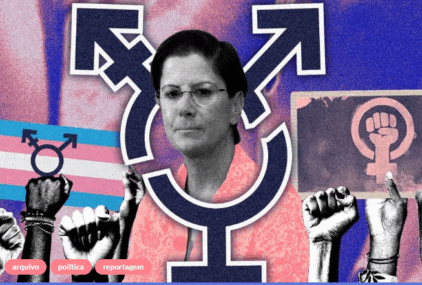
UN rapporteur promotes transphobia during Brazil visit
In meetings at the Supreme Court, Congress, and Brazilian universities, Reem Alsalem made anti-trans statements and was criticized by feminist and LGBTQIAPN+ organizations. By Dany Avelar (AzMina website), translated by SPW.