
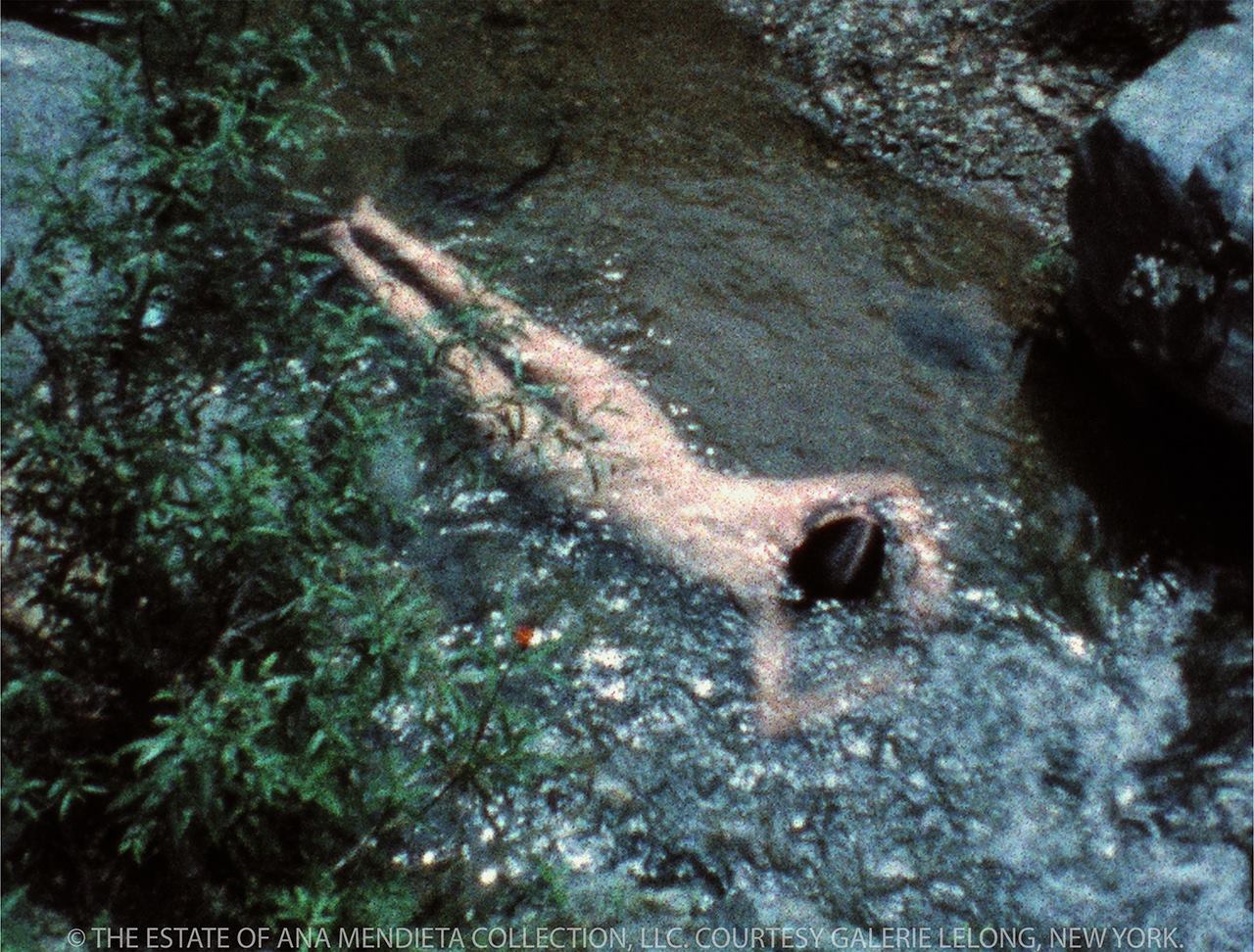
In November 2015, we have published a brief note on Ana Mendieta´s artwork, which underlined the central place of bodies particularly her own body, in her prolific production of performative interventions. Mendieta´s aesthetics is not about the female body in itself, but rather about body as part of the world and imprinted on its surfaces. In Mendieta’s own words:
“I have been carrying on a dialogue between the landscape and the female body (based on my own silhouette) … I am overwhelmed by the feeling of having been cast from the womb (nature). Through my earth/body sculptures I become one with the earth… I become an extension of nature and nature becomes an extension of my body…”
Our 2015 post also recalled that Mendieta was born in Cuba, in 1948, and died in 1985 in New York, her death surrounded by strong suspicions that she had been thrown from a 13th floor window by her husband, the minimalist sculptor Carl Andre. This tragic death made of Mendieta an icon of the subaltern place of women in the male dominated world of art.
The New Yorker in its July 12th 2026 issue published a long article that retraces in detail Mendieta´s biography and artistic endeavors a recapturing that reveals how deeply her trajectory was intertwined with the contemporary political history of Cuba. The article recalls that Ana´s privileged father, Ignacio Mendieta, collaborated with the C.I.A. to destabilize the 1959 revolution work against the rise of Fidel Castro. Concerned for his family’s safety, he sent Ana and her sister to the United States, with other 14.000 children, through what became known as Operation Peter Pan.
The description offered in the article of how the sisters initially disembarked in a refugee camp in Florida before being dispatched to an orphanage in lowa, where a local family assumed the role of their foster parents. The parallels between how the girls were treated in their “new families” and the anti-migrant brutal sentiments now prevailing in the US are striking, as illustrated by the admonition deployed by one of these foster parents: “I don’t care who you were in Cuba-you’re nobody in this country!”
Mendieta has never lost her emotional contacts with Cuba. She went back to the country, was officially recognized as a major Cuban artist and, most principally, shortly before her death developed a series of magnificent down to the earth of the island performative installations, of which the better know is Pain of Cuba/The body I am. Rebecca Mead, in the New Yorker piece, insightfully describes Mendieta´s art explorations as follows:
“The certainty of destruction was an essential dimension of Mendieta’s art. The outline of a body that Mendieta stamped into river mud would inevitably be eroded by weather and water; the feathers that she stuck to her skin could disperse as she ran naked along a beach.”
In these dark times — as the “Donroe” doctrine redefines politics in the Americas south of the Rio Grande and in the Caribbean – we considered it inspiring to revisit the complex elements in Ana Mendieta’s personal journey which densely overlaps with aesthetic and conceptual legacy.