

Far-Right’s electoral victories in Colombia and Germany and their effects
This mini newsletter has been published during the week of October 19th as Brazil heads toward the runoff of a decisive presidential election, the results of which will determine the future of democracy in the country. It discusses the first round of voting but also contextualizes the Brazilian election in relation to two other electoral events. The first is Colombian presidential elections held in June; the other, farther afield, is the German state elections that took place in September. This editorial choice seeks to underscore, once again, that what is happening in Brazil—while it may have its own unique characteristics—is not exactly exceptional.

Two Months of De la Espriella’s Administration – An Interview with Viviana Bohórquez Monsalve
“My assessment is that we are facing an administration that sows fear every day, and seeks to shift the boundaries of what we consider acceptable in a democracy.”
A Brief Note on the Post-Election Context in Colombia
As Abelardo de la Espriella’s second month in office began, the fiscal issue had dominated much of the public discourse, overshadowing the government’s other priorities. However, significant shifts in the balance of power were already becoming apparent, such as a phased effort to purge public and private institutions. In particular, a fierce campaign of systematic and sustained delegitimization against the media has erupted. There have also been attempts to intervene in professional and business associations and councils, indicating that Abelardo is waging a battle for power in both the public sphere and private entities. Por Alejandro Gamboa.

What Do the AfD’s Successes in Germany’s Recent State Elections Mean?
The recent state elections in Germany have confirmed a profound transformation of the country’s party system: the Alternative für Deutschland (AfD) is no longer a marginal political force and has established itself as one of the main electoral vehicles of the German far right. In Mecklenburg-Vorpommern, in the northeast of the country, the AfD emerged from the September 20, 2026, elections as the party with the most votes, with 38.2% of the vote, ahead of the Social Democratic Party (SPD), which received 35.5%. This marks a significant break with the country’s recent political history, as the SPD had been the leading party in every state election since 1998. By Alrik Schubotz.

Examining the first year of Leo XIV´s papacy: a conversation with Stefano Fabeni
We once again invited Stefano Fabeni to assess the political paths, breakthroughs and ambivalences at play during the first year of the first North American pope. We thank him for his time and enlightening insights!

The new dimensions of anti-gender politics in Brazil: report
This brief report was prepared by ANTRA-SPW-NUH/UFMG to inform the international public about these developments, which occurred immediately prior to the ILGA LAC Conference. It recaps and synthesizes the findings of recent reports on the current state of anti-gender politics in Brazil, with a special focus on the growing role of feminist currents that exclude trans people in the Brazilian context.
Mixed Signals: Gender Politics in March 2026
For several decades now, March has been the month when women’s rights are celebrated. The original intent of this newsletter was to draw attention to the mixed and disturbing signals we observe in the troubled landscape of March 2026.

Trump-like Jesus AI depiction: fallout and analysis compilation
EnglishTrump posted an AI image of himself as Jesus. This time even his supporters are pushing back – Fast Company Italian PM condemns ally Trump

Statement on the Hungarian Election from MCC Brussels
Sunday’s Hungarian election saw an unprecedented exercise of democratic rights by the Hungarian people. They voted in their millions for change, and Prime Minister Viktor
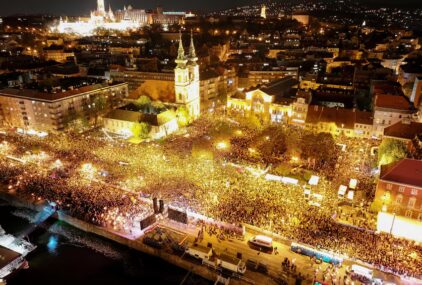
Orbán’s regime fall in Hungary: compilation of news and analysis
English A Loss for Mar-a-Lago and Moscow: Orban’s Once Unassailable Rule in Hungary Ends – Balkan Insight Orbán’s Defeat Marks Democratic Renewal in Hungary, Signaling