
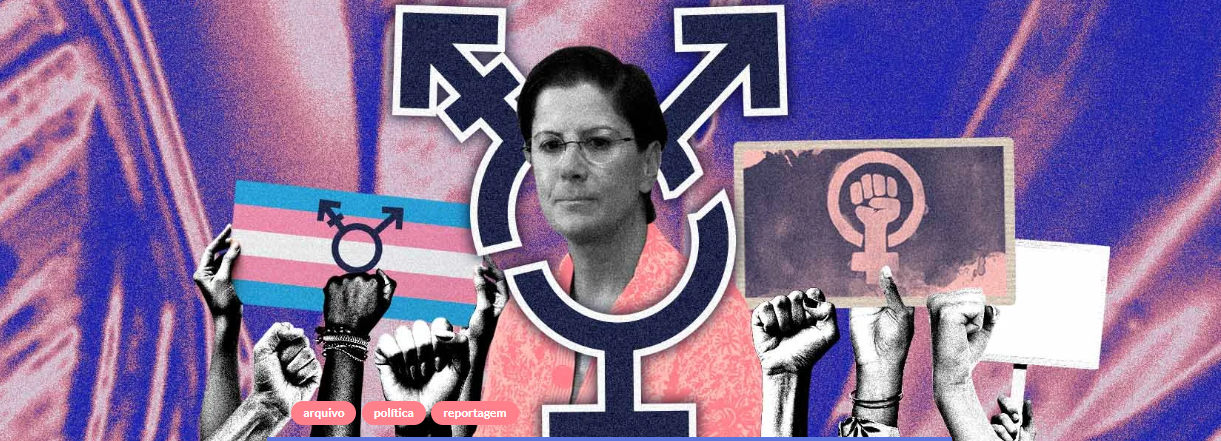
In meetings at the Supreme Court, Congress, and Brazilian universities, Reem Alsalem made anti-trans statements and was criticized by feminist and LGBTQIAPN+ organizations.
By: Dani Avelar
Originally published in Portuguese at AzMina
During an academic visit to Brazil, the UN Special Rapporteur on violence against women and girls, Reem Alsalem, was transphobic and stated that trans men are women and defended the exclusion of trans women from women’s spaces. She was received at the National Congress, the Federal Supreme Court (STF), and the University of Brasília (UnB), in addition to meeting with civil society organizations in the context of Women’s Day activities.
“Being a man or a woman is a material reality, like a chair or a giraffe. Women are adult biological females, and men are adult biological males,” Reem said in an interview with AzMina. The rapporteur’s statement is transphobic in that it resorts to biological determinism and denies that gender is primarily a social construct.
The rapporteur acknowledges that transgender people have the right to participate in society with dignity, equality, and respect. However, she argued that excluding travestis and transsexuals from women’s spaces is a necessary measure for the safety of women and girls. There is no evidence, or even indications, that segregating transgender women reduces violence against women and girls.
“Let’s look at women who do not identify as women, also known as trans men. They are still biologically women, but their gender identity is not that of a woman. I consider them to be women under my mandate, because no matter what their gender identity is, they are women,” said the rapporteur, disrespecting the rights of transgender people.
Reem came to the country at the invitation of Matria (Association of Women, Mothers, and Workers of Brazil) for meetings with social movements in São Paulo on March 1. Under the pretext of protecting women and children, Matria promotes litigation in the judiciary against quotas for transgender people in public universities and files bills to segregate bathrooms based on birth sex, among other anti-trans lobbying actions.
After her schedule in São Paulo, the UN rapporteur traveled to Brasília, where she requested meetings with representatives of the executive branch, but was not received. The Ministry of Women was contacted by AzMina journalist, but did not respond before this article was published. The Ministry of Foreign Affairs confirmed in a statement that it had been informed of the UN rapporteur’s visit.
In a lecture at the University of Brasília on March 3, Reem Alsalem said that the state has a duty to promote policies to protect transgender women who are victims of violence in the context of prostitution. However, she argues that these initiatives should be separate from efforts to combat violence against women and girls.
“We are not helping anyone by saying that these people are women and therefore face the same things as women,” she said. In 2025, the STF unanimously extended the protection of the Maria da Penha Law to male same-sex couples, travestis, and transsexuals.
The UN rapporteur continued with her transphobic speech: “violence against women means violence by males against females.” She also advocated for the abolition of prostitution and surrogacy, comparing these practices to slavery. Reem also described lesbian women as “females who love females” — a lesbian woman in the audience told reporters she was offended by the statements.
Reem took photos with the audience after the event, which brought together around 50 people and was organized by Professor Valeska Zanello, a lecturer at the Institute of Psychology at UnB. The event had been advertised as a Master Class for the PhD Program in Clinical Psychology and Culture (PPG-PsiCC), but the page has since been taken down. When contacted by reporters to explain the reason, UnB did not respond.
The UN representative’s statements become even more serious in light of the reality in Brazil, which recorded the murder of 80 transgender people and travestis in 2025, according to the annual report of the National Association of Travestis and Transsexuals (Antra). “The mandate of the (UN) Rapporteur should not be perceived as a space of tension between cis and trans women, nor as a stage for conceptual disputes that contaminate the objective of policies designed to eradicate violence,” Antra said in a letter addressed to Reem on March 2.
During a public hearing at the Senate Human Rights Commission on March 5, the rapporteur argued for a ban on trans-specific health services for children and adolescents. “Because they are children, they cannot consent to procedures, such as marriage or medical transition, that can have lasting negative impacts,” she said.
In Brazil, medical procedures have been banned for minors under the age of 18. What is provided for transgender children and adolescents is psychological care, multidisciplinary monitoring, and support for families.
Reem also spoke in favor of repealing the Parental Alienation Law and suggested the creation of a Parliamentary Commission of Inquiry (CPI) on violence against women.
The public hearing was an initiative of Senator Damares Alves (Republicans-DF), who accused trans activists of aggressively trying to occupy women’s spaces. After saying that she loves travestis and trans people, Damares called transgender athlete Tiffany Abreu a man.
The event was attended by psychologist Celina Lazzari, director of Matria, who criticized the Supreme Court’s 2018 ruling on ADI (Direct Action of Unconstitutionality) 4275. The Supreme Court’s decision authorized travestis and transsexuals to change their name and sex based on gender self-determination.
The abortion agenda
Also present at the public hearing, lawyer Andrea Hoffmann Formiga, president of the conservative think tank Instituto Isabel, stated that “the legalization of abortion cannot be presented as a solution to violence against women.” She represents the American anti-abortion organization Alliance Defending Freedom (ADF) in lawsuits in Brazil.
Regarding abortion, Reem limited herself to classifying as positive the fact that some countries offer counseling and services in all aspects of reproductive and sexual health rights, including family planning and maternal health.
However, the rapporteur has the support of the ADF, the organization responsible for the legal argument that led the U.S. Supreme Court to overturn the right to abortion as a constitutional guarantee in 2022. In an article for Newsweek in June 2023, ADF director Giorgio Mazzoli said that her positions are a “necessary breath of fresh air.”
The debate also included the participation of lawyer Cristiane Britto, who was Minister of Women, Family, and Human Rights in the final months of former President Jair Bolsonaro’s administration. The current Minister of Women, Márcia Lopes, was invited but did not attend the Senate hearing.
Received at the STF by Minister Cármen Lúcia
Reem was also received at the STF by Minister Cármen Lúcia. When questioned by AzMina about the content of the meeting, the UN rapporteur said she had presented her positions on issues relevant to Brazil, as well as seeking to understand the grounds for some of the court’s decisions.
The STF stated in a note that the hearing with the rapporteur was an institutional visit. According to the note, during the meeting, Cármen Lúcia reinforced the Court’s leading role in defending the equal fundamental rights of all people regardless of gender.
Academic mission took place after double cancellation of visit to Brazil
Reem, who is Jordanian and has Belgian citizenship, was chosen for the position in 2021 by decision of the UN Human Rights Council. She received an invitation from the Jair Bolsonaro government for a mission to Brazil in May 2022, but the commitment was postponed at the request of the rapporteur.
Acting as volunteers, UN special rapporteurs may be invited by countries to conduct field visits to monitor public policies and produce reports with recommendations to national authorities. Rapporteurs may also conduct academic visits as long as they do not issue recommendations to state actors, in accordance with the Code of Conduct that regulates their activities.
The rapporteur had an official visit to Brazil scheduled for July 2023, but it was postponed by the Lula administration, with no new date set. In May 2024, Reem shared a post on X/Twitter demanding explanations from Brazilian authorities about a leaked audio recording. In the recording, an alleged advisor to the Ministry of Women says that the visit was postponed because of the rapporteur’s anti-trans positions.
Countries that financed the visit to Brazil were not disclosed
During the interview with AzMina, the rapporteur stated that the UN is facing a budget crisis, so her visit to Brazil and other activities of her mandate are not funded by the organization’s regular budget.
The trip was reportedly financed through donations she obtained from some countries and which were transferred to the Office of the United Nations High Commissioner for Human Rights (OHCHR). When asked which countries contribute financially to her mandate, the rapporteur replied: “That doesn’t matter, or shouldn’t matter.”
A report on the activities of the UN Human Rights Council’s special procedures in 2024 reveals that Reem’s mandate received a donation of US$70,000 from Saudi Arabia. The document also shows that, from December 2023 to June 2025, Reem received external support from research assistants at the Universidad de la Sábana in Colombia. The educational institution is a corporate work of Opus Dei, an ultra-conservative Catholic organization.
The report requested information from OHCHR about the external aid and donations received by Reem’s mandate in 2025 and 2026, but received no response by the time this article was published.
Before Brazil, visits to Mexico and Colombia with an anti-trans agenda
The UN rapporteur’s academic visit to Brazil was part of a broader tour through Latin America. In February, Reem visited Mexico and Colombia, where she also gave lectures at universities and met with state actors and representatives of social movements. In both countries, the visits generated reactions from civil society.
A letter signed by feminist movements and human rights organizations addressed to Mexican lawmakers stated that “the rapporteur’s public positions reflect an approach that excludes women in all their diversity, particularly trans women and sex workers.”
In November 2022, Reem sent a letter to the Scottish Parliament criticizing the proposed reform of the Gender Identity Act. Until then, her anti-gender views were not publicly known.
Since then, the rapporteur has advocated for the exclusion of transgender athletes from sports and the return of gender testing, in addition to expressing support for sexual and gender reorientation practices, known as conversion therapy or “gay cure.”
She also celebrated the British Supreme Court’s April 2025 ruling that determined that trans women are not women. And she recently recommended the elimination of the term “sex work” from documents of the Committee on the Elimination of All Forms of Discrimination against Women (CEDAW).
Organizations criticize Reem Alsalem’s anti-gender positions
The National Council for LGBTQIA+ Rights in Brazil issued a statement on Reem’s work in November 2023, expressing concern about “positions aligned with those defended by the far right and radical social segments that flirt with transphobia.”
In May 2023, the Association for Women’s Rights in Development (AWID) published a manifesto signed by hundreds of feminist collectives and human rights organizations. “Any approach that adopts selective criteria or relativizes the legal recognition of gender self-determination and the right to free expression of gender identity already consolidated can produce institutional tensions and legal uncertainty”, the document says.
The Lemkin Institute for the Prevention of Genocide published a statement in November 2025 stating that the rapporteur uses misinformation to promote an anti-trans agenda. “Violence against women and children cannot be combated by turning vulnerable members of the population into scapegoats,” the entity states.
*The reporter traveled to Brasília at the invitation of SPW ABIA.
** Editing: Jane Fernandes, Joana Suarez, and Helena Bertho /// Artwork: Lory Costa
*** Text revised using AI.